History
The History of Uneallika Puhketalu – A Place, a Journey, and the People
A Place With a Story
Through a series of dreams and meaningful experiences, it became clear that this place deserved a chance to breathe again.
Uneallika’s journey began quietly, without a grand plan. There was an inner calling that could no longer be postponed. That is how a place was born where the past and the present can exist side by side—sometimes in sunshine, sometimes under clouds, but always real.

The Keepers of Uneallika
Helena and Leonhard
The History of the Place
The Sea, the Village, and Ancient Settlement
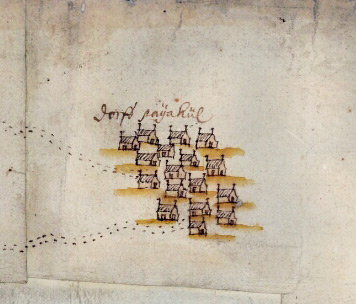
About a thousand years ago, Pae village was located by the sea. At that time, the sea level was approximately 10 metres higher, and the wet, marshy landscape extended as far as the present-day Uneallika property.
The Vihterpalu River together with the Leidissoo bog is a remnant of a former fjord-like body of water, along whose shores ancient settlements once existed. The beginning of this settlement is dated to the end of the 1st millennium and the beginning of the 2nd millennium.
Pae village is first mentioned in the Danish Census Book under the name Pathes. It is believed that in the 13th century the area may also have been connected to Cistercian economic activity.
If you want to explore the area on site, see also where to go around Uneallika.
From Hallika to Uneallika
The name Uneallika consists of two parts. The former name of the farmstead was Hallika, referring to the natural springs found here.
There are several springs on the land, and wells have historically been built above some of them—Uneallika has two. The springs existed here before the houses and shaped the character of the place long ago.
The current name, Uneallika, emerged through the owners’ dream journeys and experiences. This is how a place was formed where natural water and inner exploration became one story.
A New Beginning Since 2015
The new chapter of Uneallika began on 9 April 2015. This marked the start of the farm’s second life.
Ancient Sites and Finds in the Surroundings
Viking Age burial sites are located around Uneallika, dating from the 9th to the 13th century. These finds provide insight into the region’s prosperity, way of life, and also past conflicts.
The oldest find comes from Leidissoo—a roughly 2,500-year-old bronze arrowhead , which was formally handed over to the National Heritage Board.
Local Viking Age burial sites gradually reveal their archaeological heritage. In the skilled hands of the lady of the house, a jewellery collection has been created, inspired by local finds and the heritage of the surrounding area.
If you want to see how the finds and patterns have been transformed into jewellery, visit Uneallika jewellery.

The Year Was 2015
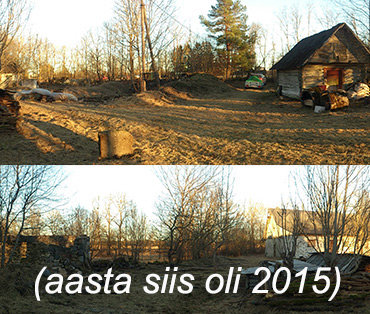
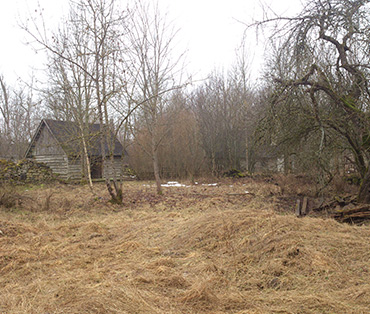
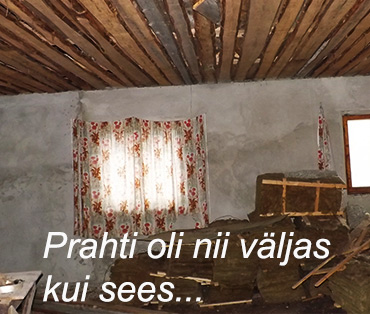
When we began here in 2015, we faced buildings worn down by the collective farm era, a yard full of debris, and land without landscaping. There was only an ancient spring—and the certainty that this was enough to begin.
The work was done step by step. A tractor driver named Jüri from the neighbouring village helped, the roof of the Lättekoja was built by craftsmen from Saaremaa, and everything else took countless hours spent in the shared rhythm of the two keepers of Uneallika. For seven consecutive years, almost all weekends and holidays were devoted to this work.
Today, all buildings that were more or less intact have roofs once again.
There are plans to add a roof to the former sauna, but it will deliberately remain in the form of a ruin—like Padise Monastery. One day, the old summer kitchen by the spring may also be brought under a roof, but that will take time.
We have fully enjoyed this journey—now it is your turn to experience it in your own way. The journey continues, simply at a calmer pace.
If you want to come with your group and experience Uneallika for real, see the main page for Uneallika’s houses and possibilities.




The Years Go By and Recognition
2022
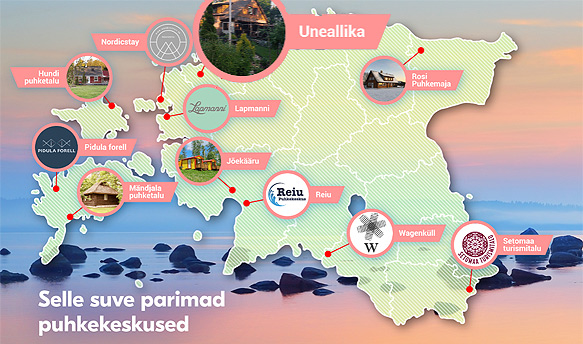
Over the years, Uneallika has gained maturity, calm, and visibility. In 2022, Uneallika was highlighted in a Postimees article “The Best Holiday Homes of This Summer”.
Location
You can enjoy rural life while still being close enough to the city.
In Between
A short drive in one direction takes you to the sea for swimming, in another to the forest for a walk, and in a third to the shop. A bit further lie Padise, Haapsalu, and Tallinn.
A Historic Place
Uneallika lies on the edge of an ancient village—a place where life has continued for centuries.
Come and Rest
If your route brings you past Uneallika, we recommend taking the time to stay, even for a day or two. It is simply good to be here.